Built for women

Your doctor said your tests were normal.
You're still exhausted.

Upload your existing blood work. We read it against functional ranges used in integrative medicine, connect it to your cycle and wearable data, and tell you what's worth testing next. Not a replacement for your doctor. A way to walk into the next appointment knowing what to ask.

We're building this with you.

Functional ranges
Not just "normal"
AI companion
Ask anything about your results
Wearable sync
Apple Health + Health Connect
Gap analysis
Know what to test next

Takes five minutes. No clinic visit.

If you've got a blood test PDF, that's enough to start.

01

Upload whatever you have

That CBC from last month, the thyroid panel from six months ago. Upload the PDF. Doesn't matter how old or how incomplete. We'll work with what you've got.

02

See what your doctor's report didn't say

We'll show you which markers are functionally low even if they're "in range," which ones are drifting, what's missing entirely, and what the combination actually means for the way you've been feeling.

03

Walk into your next appointment with a plan

Ask the AI companion anything. Sync your wearable and cycle data for more context. Then take a generated test list to your doctor and say "I'd like these checked." That conversation is usually the hardest part. We make it easier.

What it looks like

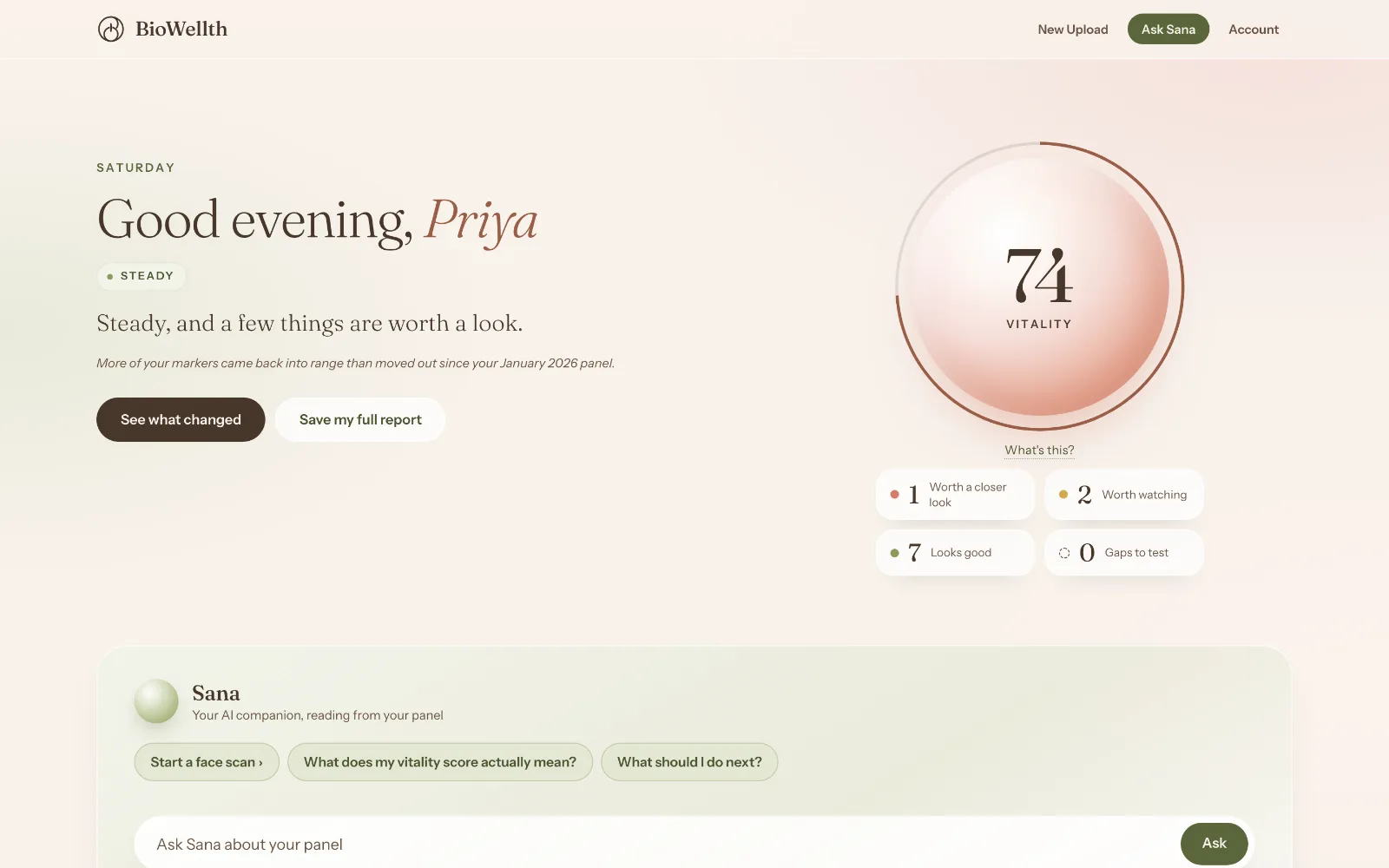
This is a real result. The lab said it was normal.

Clinical reference ranges are statistical. They cover roughly 95% of the tested population, so you only get flagged if you're near the bottom or top 2.5% (Mayo Clinic). Functional ranges, used in integrative and functional medicine practice, are narrower and focus on where people tend to feel and function best. They're not RCT-validated the way clinical thresholds are.

Ferritin is a useful example. Most Indian lab reports list the female reference range as roughly 10 to 150 ng/mL. Functional medicine commonly targets 70 to 100 ng/mL for women with heavy periods or high activity levels. Cleveland Clinic notes ferritin under 30 ng/mL is linked to iron deficiency symptoms even when haemoglobin is still normal.

A ferritin of 28 ng/mL sits inside the clinical range but is functionally low for a woman.

Ferritin (iron stores)
28 ng/mL · Inside clinical range (10 to 150). Functionally low; integrative medicine targets 70 to 100. (Cleveland Clinic; IFM)
TSH (thyroid)
2.1 mIU/L · Inside clinical (0.4 to 4.5) and functional targets (1.0 to 2.5). TSH alone doesn't show what's reaching your cells. (ATA; NIH)
Vitamin D (25-OH)
32 ng/mL · Above the 20 ng/mL deficiency cut-off. ICMR-NIN reports widespread insufficiency in women; functional targets 40 to 60. (Endocrine Society; ICMR-NIN)
⚑ Not tested
Free T3, Free T4, Progesterone, DHEA-S, hsCRP, Cortisol. These markers matter for how you feel. Ask your doctor to run them.
AI companion

"I keep waking up with headaches. Is something off?"

BioWellth's AI companion connects your blood work, wearable data, symptoms, and environmental factors like air quality to surface patterns a single data source would miss.

The kind of question you Google at midnight and get 47 conflicting answers. Our AI has your blood work, your sleep data, your local AQI, and what you've been logging. It reads them together.

I've been waking up with headaches every morning this week. Is something off?
A few things are lining up. Your Apple Health data shows sleep quality dropped 30% this week, with wake-ups around 4am most nights. AQI in your area has been above 150 for five straight days. That level of PM2.5 exposure has been linked to headaches and sleep disruption in WHO air-quality reviews. Your last blood work showed ferritin at 32 ng/mL, on the lower end functionally. Any one of these on its own can nudge how you feel. Together, it's a pattern worth watching.
What should I do?
Short term, keep windows closed and run an air purifier while AQI stays high. Retest ferritin. It was borderline three months ago, and if it's dropping, that's a conversation to have with your doctor about iron supplementation and checking for underlying causes. This is information, not a prescription.
Gap analysis

Your last checkup probably didn't test for any of these.

Standard Indian "executive" or "master" health check packages typically include CBC, lipid panel, fasting glucose/HbA1c, liver and kidney panels, and TSH. Markers like ferritin, Free T3, Free T4, progesterone, morning cortisol, hsCRP, and DHEA-S are usually separate add-ons and rarely bundled by default. And that's just a handful of examples. We look at over 245 markers across 21 categories.

Those are the markers most relevant to fatigue, cycle symptoms, brain fog, and low-grade inflammation. They're the ones we flag as gaps.

My mother was tired for three years before we figured out why. Every checkup came back "normal." Nobody ran ferritin. Nobody ran hsCRP. Her haemoglobin kept looking fine, so nothing got flagged. Meanwhile her iron stores had quietly emptied out, and underneath that, chronic inflammation that nobody looked for because nobody ran the right tests. By afternoon she was barely functioning. When we finally got ferritin and hsCRP run, the answers were sitting right there. None of it was hidden. It just wasn't looked for.

That's what this is. We flag the low ferritin. We also ask why it's low. Someone should have asked three years earlier.

Aditi Pillai, Founder

Tested
7 categories
Not tested
14 categories
Key missing markers
Free T3 & Free T4
TSH is the first-line screening test. It tells you how hard your pituitary is pushing your thyroid, not what's actually circulating. Free T3 and Free T4 show the hormones reaching your cells. TSH can sit inside the reference range while Free T3 runs low in a subset of thyroid dysfunction. Worth running if you've had "normal TSH" reports and still feel off. (NIH StatPearls; American Thyroid Association)
Ferritin
Your haemoglobin can look perfectly fine while your iron stores are already running on empty. Ferritin catches that months before it shows up anywhere else. (Cleveland Clinic)
Progesterone (luteal phase)
Timing matters. Progesterone peaks roughly 7 days after ovulation, so the test should be drawn in the mid-luteal phase, about 7 days before your next expected period. For a 28-day cycle that's around days 20 to 23; for a 32-day cycle closer to day 25. A value drawn outside that window doesn't tell you much. It's rarely bundled in standard panels. (ACOG; NIH)
hsCRP
A general marker for systemic inflammation. An elevated hsCRP means inflammation is present. It doesn't say where it's coming from. Common drivers include infection, autoimmune activity, visceral fat, and chronic stress. If hsCRP is high and your iron and thyroid are fine, it's a signal to keep looking, not a diagnosis on its own. (Mayo Clinic; AHA)
Cortisol (AM)
Your core stress hormone, highest in the morning and lowest at night. Morning cortisol typically runs 6 to 23 µg/dL on clinical labs; functional medicine looks for the pattern, rhythm and ratios, more than any single number. Chronically high or flat cortisol rhythms are linked to broken sleep, afternoon energy crashes, and stubborn weight, though it's rarely the only factor. Standard check-ups in India don't include it by default. (Endocrine Society; NIH)
Generate a test request list for your doctor →

You probably recognise yourself here

Dismissed

"I've been tired for two years. Every test comes back fine. I've stopped trusting the tests."

You know something's wrong. Your doctor doesn't see it because the markers that would explain it were never run. We read what you've already been tested for differently, and we flag what should've been included but wasn't.

Curious

"I got my blood work back. The report says normal. What does that actually mean?"

"Normal" means you're not in the bottom 2.5% of the tested population. That's it. You want to know if you're actually well, not just not-sick-enough-to-flag. That's a fair thing to want.

Ahead of it

"I don't have symptoms yet. I just want to know."

Some of the most important shifts happen in people who feel completely fine. Markers quietly drifting the wrong way, the kind of drift that takes two or three years to become a symptom.

We're pre-launch. We're not going to put up testimonials we don't have yet.

If you're one of the first 100 and this changes a conversation with your doctor, we'd love to tell your story here. With your name, only if you want it up.

BioWellth is educational. We interpret existing test reports against functional ranges used in integrative medicine practice. We don't diagnose, treat, or prescribe. Functional ranges are narrower than clinical ranges and are based on expert consensus in functional and integrative medicine, not randomized clinical trials. Always discuss your results with a licensed clinician before acting on them.

We're looking for 100 founding members.

You get full access to everything we're building. We get to learn what actually matters to you.

Get early access

Your health data is yours. We don't sell it, share it with third parties, or use it for advertising. Ever. Your reports are encrypted, access is private, and you can delete everything at any time. We're building a health tool, not a data business.

Full data-handling details and your rights under India's DPDP Act, 2023 are in our Privacy Policy.

100 founding members. Free access.

Full access to everything we're building. Your feedback shapes what comes next.

Full access, no cost

Functional interpretation, AI companion, wearable sync, and gap analysis. All included for founding members.

You shape what this becomes

We're not building in a vacuum. Your feedback directly changes what we build next.

Founding member rates

Founding members get the lowest price we'll ever offer when BioWellth opens publicly.

Your health data is yours. We don't sell it, share it with third parties, or use it for advertising. Ever. Your reports are encrypted, access is private, and you can delete everything at any time. We're building a health tool, not a data business.